• Link to X
  • Link to Facebook
  • Link to LinkedIn
  • Link to Rss this site
David M. Jessup
  • Home
  • About the Author
  • Books
    • Mariano’s Crossing
    • Mariano’s Choice
    • Mariano’s Woman
  • Public Speaking
    • Talk Topics
    • Tour of Historic Sites
  • Press Resources
  • Blog
  • Contact
  • Click to open the search input field Click to open the search input field Search
  • Menu Menu
Eco-friendly beef

Livestock Improve Water Holding Capacity of Soil
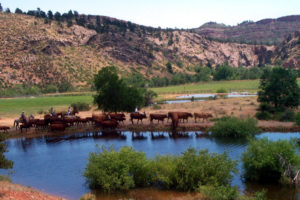
Here at Sylvan Dale we are using cattle to help build up organic matter and carbon content of our soils.  The technique:  planned, rapid rotation grazing.  It turns out this also helps the soil conserve water.  Here’s a post from Dr. Roy Roath, CSU Professor Emeritus, describing a grazing experiment he conducted on range land in Northern Colorado:

In a program implemented north of Fort Collins in a ‘short grass prairie” receiving an average of 10-12 inches of annual precipitation; we implemented a grazing program designed explicitly to greatly increase water capture and retention. This requires a designed rotational grazing program to allow use, foster tillering and plant recruitment and management for growth and regrowth to full recovery in every pasture every year. In doing this we were able to increase forage on offer, leave greater residual cover and increase the diversity of the stand including greatly increasing the forb component. What we found is that the “short grass prairie” was really a mixed grass prairie suppressed by years of inappropriate grazing. We soon had major increases in cool season grasses and forbs and many tall warm season grasses that were not evident and not even thought to be a part of this ecosystem when we started. After five years in this program we had two dry streambeds that became streams that flowed 365 days a year and began to grow riparian vegetation the full length of their corridor. A critical part of this management strategy is to regain and manage cover on the primary terraces bordering the streambed. These are water storage areas and must have structure and cover to maintain the integrity to the stored water in the system. I can’t say that this works everywhere but I have enough experience in a variety of environments to know that one can vastly improve water capture and in doing so has a great probability of good things happening.

March 23, 2013/by David Jessup
Share this entry
  • Share on Facebook
  • Share on X
  • Share on LinkedIn
  • Share by Mail
http://www.davidmjessup.com/images/Signature-David-J-just-one-for-inserting-1-300x119.jpg 0 0 David Jessup http://www.davidmjessup.com/images/Signature-David-J-just-one-for-inserting-1-300x119.jpg David Jessup2013-03-23 09:20:442017-04-28 13:52:47Livestock Improve Water Holding Capacity of Soil

Archive

Catagories

  • Books
  • Books of the West
  • Comments
  • Eco-friendly beef
  • Events
  • Fish Tales
  • Grass-fed Cattle
  • Healthy Beef
  • Humane Beef
  • Local Beef
  • Media
  • News
  • Ranch Stories
  • Tender Beef

CONNECTIONS

Amazon
Beef, Books, Boots
Facebook
Goodreads
LinkedIn

ASSOCIATIONS

Big Thompson Watershed
Heart J Center
Parenting With Courage and Uncommon Sense
© 2014 David M. Jessup

Home    |    About    |    Discussion

Recent Posts

  • Mariano’s Woman selected as finalist by Colorado Author’s League Book Award
  • Snow Storm Prep for Ranchers
  • My interview on Cowboy Up Podcast

|    Excerpt    |    Calendar    |    Contact

Site by Applaud Media
© Copyright 2016 - David M. Jessup - Site design yohannajessup.com - Enfold WordPress Theme by Kriesi
  • Link to X
  • Link to Facebook
  • Link to LinkedIn
  • Link to Rss this site
Link to: Can Livestock Save the Planet? Link to: Can Livestock Save the Planet? Can Livestock Save the Planet? Link to: Super Bugs in your Meat Link to: Super Bugs in your Meat Super Bugs in your Meat
Scroll to top Scroll to top Scroll to top